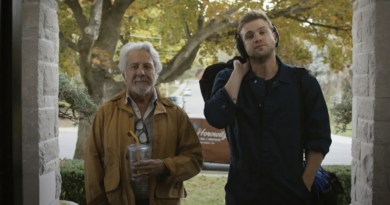

“All About the Money” Pulls the Curtain Back on Fergie Chambers and His Obsession With Making Things RIght, One Way or Another
Studio: Albert Media Group
Director: Sinead O’Shea
A Piercing Documentary About the Power of Wealth and Whim, Director Sinead O’Shea’s All About the Money Takes Viewers on a Fascinating Journey into the Inner Conflicts that Rule One Percenter James Cox Chambers.
Making its World Premiere in the 2026 Sundance Film Festival World Cinema Documentary Competition this January, All About the Money probes the deep and abiding conflicts that rule James Cox (aka Fergie) Chambers. We all have inner conflicts of some sort or another, of course. What makes Chambers so compelling a subject? He’s son to one of the richest families in America, and his antipathy springs most from the source of his power to grapple with it, capitalism.
Great grandson to James M. Cox, ex-governor of Ohio and 1920 Democratic presidential nominee, his family’s holdings include Cox Enterprises, a $34B media conglomerate with tentacles in sectors spanning automotive, farming and tech, among others. Suffice it to say Chambers has the resources to make a dent in his Communist war on capitalism, yet the question seemingly posed by O’Shea’s new work may just be “Is that what he really wants?”
The fact is Chambers is a very troubled man. Raised by a single mother, actress Lauren Hamilton, his father, James Cox Chambers Sr. (heir to the Cox Enterprises fortune) sought and secured a divorce early on in his life. Estranged, for the most part, from his wealthy family, he emerged from his youth with a scathing history of mental health issues, drug abuse, a great deal of resentment toward everything the Coxes stand for, and a healthy share of their holdings. In an effort to seemingly exorcize his angst against the power and wealth his family wields, he divested himself of those holdings to the tune of $250M and began a crusade to crush the very engine that powered his own considerable fortune.
The film’s outset neatly follows Chambers’ launch of a Communist revolutionary base in rural Massachusetts, an effort to disrupt the capitalist system that comprises his foil. On a parallel track, O’Shea explores Chambers’ backstory, which feeds so succinctly into his incredibly unique focus. Throughout the film’s first half, it becomes clear that Chambers’ passion for the commune he funds emanates directly from a sense of responsibility for the glutenous feeding he feels his family contributes to in America, as well as a deep and abiding need to strike out at what they represent. Yet, it also becomes evident that the void left by an emotionally distant and what he terms a “politically evil” father might also be in some way causal. When describing his father, the 40-something multi-millionaire philanthropist seems to devolve emotionally into a scorned pre-teen seeking validation. Perhaps it is because that validation never came that Fergie Chambers jumps so easily from passion to passion, finding only fleeting satisfaction when each pursuit creates more problems than they’re seemingly worth. He steps back from the commune after a pro-Palestenian demonstration by its participants (while funded and directed by Chambers) draws the interest and ire of law enforcement. The effort quickly slides into an alleged break-in at the facility of an accused Israeli weapons supplier. Once Chambers becomes a subject of interest, he relocates to Tunis, Tunisia.
Shortly thereafter, he begins selling portions of the commune and divesting from the commune’s overall purpose. With one of his commune participants in legal jeopardy, he takes a long-handle approach to sponsoring her court-ordered restitution, communicating less and less as her jail time approaches and as others in the commune question how long they will actually be able to live there rent free.
In Tunis, Chambers moves on to sponsoring a local fledgeling soccer team, becoming something of a local folk hero in the process. That pursuit crumbles when alleged corruption is revealed, and Chambers jets off to Ireland, vowing never to return to the US.
His personal life as volatile as his political pursuits, Chambers’ romantic relationships seem to take on an equally mercurial turn when the mother of his young child leaves, and within less than a month, he marries again–this relationship lasting less than even that. Yet, what always seems to remain is a longing to fill a yet undefined void.
O’Shea weaves a fascinating picture of this increasingly complex man with lingering vignettes and quick dashes spanning months of his life. One truly frenetic scene shows Chamber’s quixotic mind at work with text exchanges in response to O’Shea’s request to resume filming after his latest jump. With plans on and off and back on again, Chambers can’t seem to maintain focus long enough to truly make real roots, and perhaps that’s the real problem.
The conclusion of the documentary is not a shock reveal, but rather an entirely predictable resolution: the unveiling of an incredibly troubled individual with enough money to do almost anything but fill the void left behind when sprawling wealth yields an empty upbringing. The irony is stifling, yet it’s unbelievably fascinating to watch. All About the Money is a compelling work that pulls the thread on a deeply troubling figure, and while ultimately not surprising, what unravels is a poignant figure who has all the wealth he could ask for to sate his inner need, and yet his thirst remains.